
Guide
What a certified translation actually looks like, page by page
It is natural to expect NAATI to certify your translation. NAATI says it does no such thing, and the difference tells you exactly what will land in your inbox and what the person receiving it can check on it.
Published 4 September 2026 · Official Translation
“Certified” describes the translator, not the document
NAATI puts it in two sentences on its page about use of the NAATI name and logo: “NAATI does not certify translations. We certify the translators who do translation work.” So nothing in the file you receive is certified by NAATI. The translator is. What you are actually buying is a translation completed by a NAATI-certified translator, who puts their name, their credential and their stamp to the work and takes responsibility for it.
The same page draws the line for businesses like ours. “Organisations and companies cannot state that they are certified by NAATI. NAATI only certifies individual translators and interpreters.” What we may say, in NAATI’s words, is this: “Organisations and companies may state that they engage NAATI-certified translators and interpreters.” That is exactly our role. We arrange the work; the translator stands behind it. See how NAATI translation works with us.
Once you know that, what there is to check is short: a translation that can be laid beside your original, a statement in which a named translator stands behind it, and a stamp carrying a practitioner number anyone can look up. The rest of this guide walks through those three things in the order they appear in the PDF.
Before we go on, it is worth saying plainly: if nobody has asked you for a certified translation, you may not need any of this. Some readers only need the content in English, and our Standard option covers that. If nobody has asked for a translation at all, you may not need us. When in doubt, ask the body you are sending the document to before you order, not after.
The translation itself, set out to follow your original
The first pages of the PDF are the translation. It follows the order and layout of your document as closely as a translation can, usually as a table that takes each field in the order it is printed, so a reader can work down the two side by side. Everything on the page is carried across: the wording on stamps and seals, handwriting and the small print on the back are all translated.
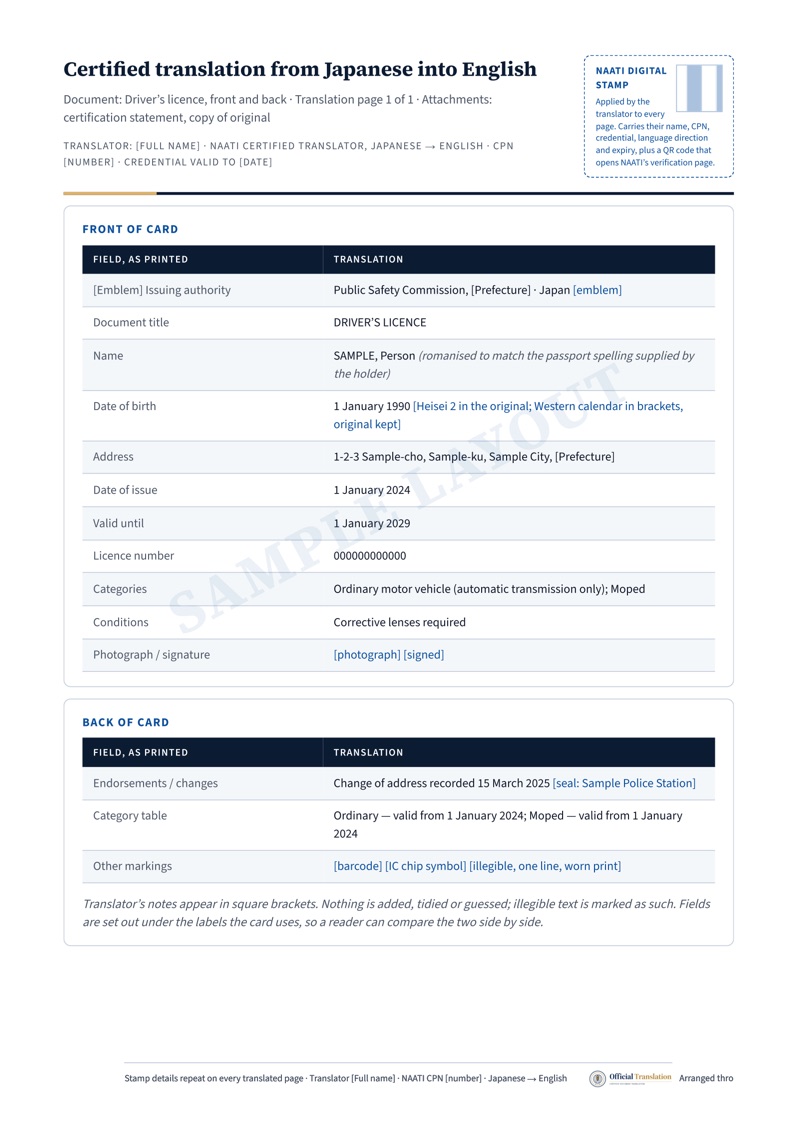
Where the translator needs to tell you something about the page rather than translate it, the note goes in square brackets: [illegible] where a word cannot be read, [signed] where a signature is, and a note such as [seal: Civil Registry Office] where an official seal sits, giving what the seal says. Nothing is tidied away and nothing is guessed. This is the convention set out in AUSIT’s recommended best practices for official and legal documents, and it is why a faithful translation of an untidy document looks a little untidy too.
It arrives as a searchable PDF rather than an editable file. That is deliberate. The point is to show what the translator put their name to, and a document anyone could retype afterwards would not show that.
The statement, the stamp and the practitioner number
After the translation comes the translator’s certification statement. It names them, gives their NAATI credential and the language direction it covers (Punjabi into English, say), and refers to the attached document as the one they translated. This is the paragraph where a real person with a checkable credential says, in effect: I made this translation and I stand behind it.
With it comes the stamp. NAATI explains what it is for: “All NAATI-certified translators and interpreters are provided a practitioner number (Certified Practitioner Number, or CPN), and a translator stamp or ID card (physical or digital) to verify their credentials and work.” The number is the part to notice. It belongs to that translator alone, and it is the detail that lets anyone, an officer included, look that translator up on NAATI’s online directory.
NAATI issues both physical and digital stamps, and the translators we engage normally use the digital one. It carries a QR code, and the words “Digitally Authenticated by NAATI” stand where a physical stamp would carry the translator’s signature. The translator applies it themselves; we never hold, store or apply any translator’s stamp. Why NAATI introduced the digital stamp, and where a printed translation is enough, is in PDF or hard copy? Where a printed translation is enough.
The copy of your original, and the same details on every page
The last part of the file is a copy of the document you photographed, attached after the translation and stamped by the translator. It is not padding. It shows exactly which original the translator was working from, so the translation cannot quietly be paired with a different document later.
The clearest explanation of why that matters comes from NAATI’s page on what the Department of Foreign Affairs and Trade (DFAT) asks of translations it will legalise. Having listed what the stamp must show, the page says: “The information above must be contained on EVERY translated page. An original or a copy of the original document, signed or stamped by the translator, needs to accompany the translated document.” Then, to every translator reading it: “NAATI recommends that you adopt this practice as the standard for any translation work you undertake.”
So that is the format NAATI recommends for every job, and the one to expect under our NAATI certification option: the stamp details on every translated page, not just the last one, and a stamped copy of your original inside the same PDF. The DFAT rule itself is a strict one: “From 1 July 2018, DFAT is only able to accept translations completed by translators with NAATI certification (this includes Recognised Practising credentials) issued under the current Certification System.” Most readers will never deal with DFAT, but the format it asks for is the one NAATI recommends for all work.
Which option to tick, and what the three-year date means
Our Standard option carries none of the above. No statement, no stamp, no practitioner number, no “certified” heading. It is a translation and nothing more, and it is the right choice only when nobody has asked for certification. The two are set out side by side on our services page, and how it works walks through the order step by step.
Two groups of readers almost always want the NAATI option. The Department of Home Affairs’ checklist for the onshore partner visa says: “Have all documents translated into English. Provide original and translated documents in your application. Translators in Australia must be accredited by the National Accreditation Authority for Translators and Interpreters.”
The Australian Passport Office says: “If your documents aren’t in English, you’ll need to get them translated in full and stamped by an accredited translator before you show them to us.” Both use the word accredited; NAATI’s own name for the credential it issues today is certification, and the stamp described above is how a translator shows it. There is more on each in partner visa document translation and translating documents for a passport application.
One more thing people ask about is the date. The three-year life you may have heard of belongs to the translator’s credential, not to your document. NAATI says: “All credentials issued under the current Certification System have a 3-year validity period and an expiry date.” That is a statement about the person: it tells you when they must recertify to keep the credential. It says nothing about the translation they completed while the credential was current.
NAATI answers the next question too. Of the “valid to” date on a stamp it says: “It does not reflect a date after which a translation is invalid or unacceptable”, and that the translation “remains valid indefinitely”. If you have a translation from a couple of years ago and a form in front of you, ask the body behind the form what it wants; a short call is cheaper than a wasted order. When you can use a translation again, and when you need a new one: does a translation expire.
Asked for a “certificate of translation”? Look for the statement
If a form or an office has asked you for a certificate of translation, or a translation certificate, the nearest thing in the PDF is the translator’s certification statement described above: the paragraph in which a named translator gives their NAATI credential and the language direction, refers to the attached document as the one they translated, and stands behind the work.
It comes with their stamp and practitioner number, and it sits inside the same PDF as the translation and the stamped copy of your original, so there is no separate certificate to ask us for. To get one, choose the NAATI certification option on the order page; the Standard option carries no statement and no stamp.
What to do with the practitioner number and the QR code once the file arrives: how to check a NAATI translator. Ready to send your document? Order online, and choose the NAATI certification option if someone has asked you for a certified translation.
Sources, checked on the date shown:
- NAATI, Use of NAATI Logo, Trademark & Other Logos (checked 4 September 2026)
- NAATI, Practitioner Identification (checked 4 September 2026)
- NAATI, DFAT Requirements for Translators (checked 4 September 2026)
- NAATI, Frequently Asked Questions (checked 4 September 2026)
- Department of Home Affairs, subclass 820 document checklist (page last updated 10 August 2026, checked 4 September 2026)
- Australian Passport Office, interpreting and translation (checked 4 September 2026)
- AUSIT, Recommended Best Practices for the Translation of Official and Legal Documents (checked 4 September 2026)